
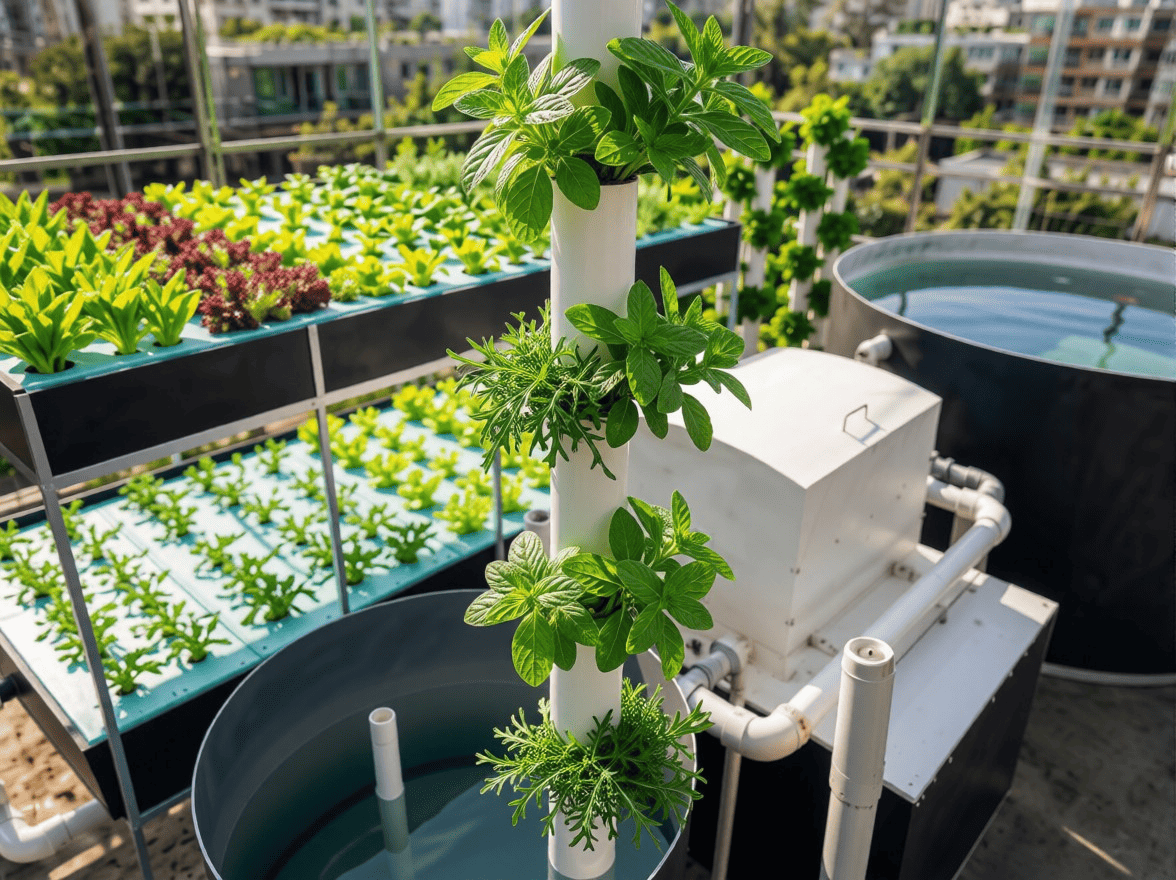
The future of hospitality grows here.
AQUAAMORI creates intelligent aquaponic environments that combine fresh food production, fish cultivation, circular water management and distinctive architecture. Designed for hotels, resorts, restaurants, wellness destinations and forward-looking communities, every AQUAAMORI system turns food production into a visible and memorable experience.
More than food production.
An AQUAAMORI installation is a working ecosystem, an architectural feature and a visible expression of responsible hospitality. It allows fresh ingredients to be produced close to the kitchen while giving guests an opportunity to experience the relationship between food, water, biology and technology.
Fresh on-site production
Grow leafy vegetables, herbs and selected crops directly at the property and reduce the time between harvest and service.
Living circular ecosystem
Fish, plants, microorganisms and water-treatment technology operate as parts of one connected production system.
Guest engagement
Transform sustainability into something guests can see, visit, understand and remember.
Architectural presence
Choose from distinctive domes, elegant capsules and adaptable glasshouse systems.
Food production designed as a living experience.
AQUAAMORI creates premium indoor and outdoor aquaponic greenhouses that combine luxury architectural design, fresh food production, fish cultivation, intelligent water-quality management and advanced automation.
Designed for luxury hotels, resorts, fine-dining restaurants, wellness destinations and private estates, AQUAAMORI transforms sustainable food production into a visually stunning, innovative and memorable experience.
Circular by nature
Water and nutrients move through a connected biological cycle.
Designed for people
Every system is planned around how guests, staff and visitors will experience it.
Built to last
Materials and construction methods are selected for durability and low maintenance.
Scalable and adaptable
Modular design allows systems to grow with demand and adapt to different spaces.
How the AQUAAMORI system works.
The AQUAAMORI aquaponic cycle is a continuous biological process. Fish produce nutrients. Water carries those nutrients to the plants. Plants absorb what they need and clean the water. Clean water returns to the fish.
Fish production
Selected fish species are raised in carefully controlled tanks. Their waste provides the organic nutrients that feed the plants.
Water circulation
Water flows continuously between fish tanks, filtration and growing areas. Mechanical and biological filters maintain water quality.
Plant cultivation
Plants grow in soil-free beds, towers and vertical structures. They absorb nutrients directly from the water.
Monitoring and control
Sensors and controllers keep water chemistry, temperature, flow and feeding within optimal ranges.
Architectural enclosure
The environment is housed in a purpose-designed structure that protects the system and creates a striking presence.
AQUAAMORI system configurations.
Every AQUAAMORI project is tailored to the client, the site and the intended production. The modular approach means systems can be scaled and combined.
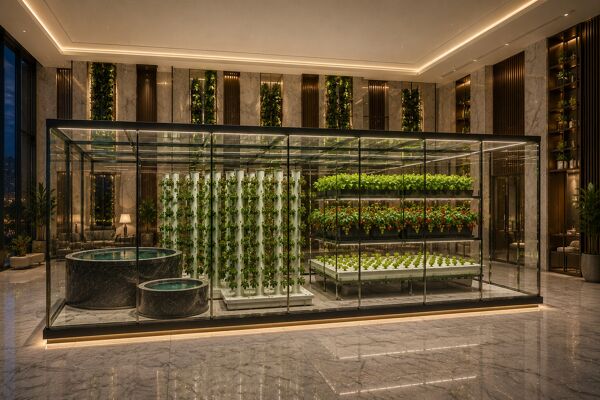
AQUAAMORI Glasshouse
A compact, elegant unit for restaurants ,wellness centres and urban areas. Designed to fit into smaller spaces without compromising impact.
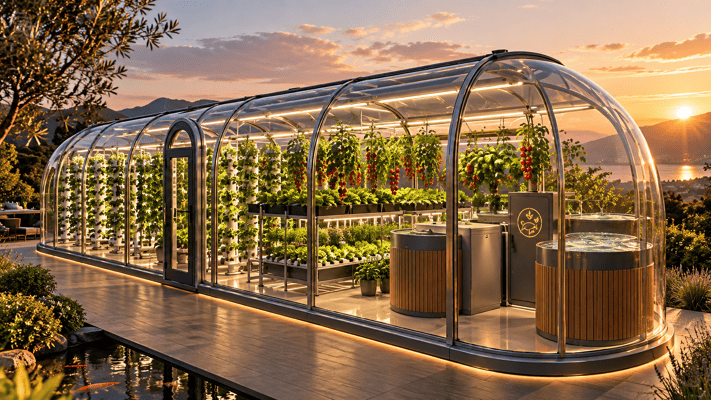
AQUAAMORI Capsule
A larger system for individual, community projects and educational institutions. Configurable for diverse crop and fish combinations.
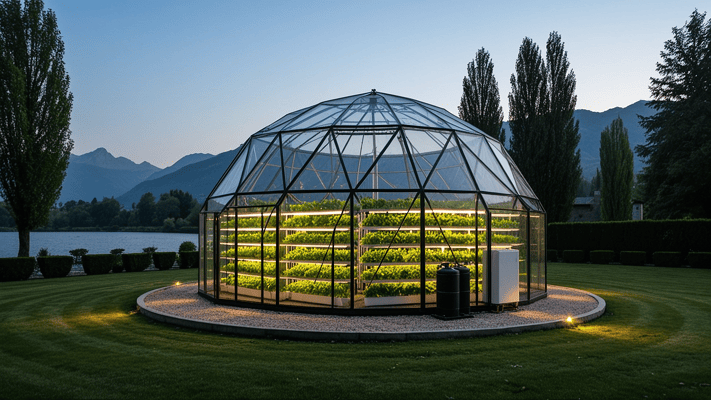
AQUAAMORI Dome
Adaptable dome-based environments designed to integrate fish production, plant cultivation and essential aquaponic technologies.
Custom configurations
For unique sites and large-scale developments, AQUAAMORI develops bespoke systems that integrate with existing architecture.
Intelligent control, reliable performance.
AQUAAMORI systems are monitored and managed through an integrated control platform that tracks water chemistry, temperature, flow, feeding and plant conditions in real time.
Remote monitoring
Water quality and system status are visible from any device, keeping staff informed without constant attention.
Automated control
Pumps, aeration, and climate systems operate automatically within set parameters. Manual override is always available.
Data logging
Historical data supports optimisation and troubleshooting, helping refine production patterns over time.
Integration ready
The platform connects with existing building management and hospitality reporting systems where required.
Aquaponics
The future of food production
What AQUAAMORI systems produce.
AQUAAMORI systems are designed for practical, high-quality food production that meets the standards of professional kitchens.
Leafy greens and herbs
Lettuce, spinach, basil, coriander, parsley, chives, mint and other leafy crops grow rapidly in aquaponic beds and towers.
Selected vegetables
Tomatoes, peppers, cucumbers, aubergines and other fruiting vegetables can be produced with appropriate lighting and climate control.
Fresh fish
Selected species including tilapia, barramundi and trout are raised to kitchen-ready size, calibrated to match kitchen demand.
Consistent supply
The controlled environment means fresh ingredients are available throughout the year, regardless of external weather conditions.
Designed for hospitality, not agriculture.
AQUAAMORI is built for properties where food production is part of the guest experience. The systems are clean, quiet, and safe for public spaces.
Guest experience
Guests can see and engage with where their food comes from. The system becomes a photo opportunity and a visible expression of values.
Kitchen integration
Fresh ingredients move to the kitchen in minutes. Chefs have access to produce that is fresher and more consistent than supply chains.
Marketing and storytelling
Installations give properties a genuine sustainability story that can be shared across marketing and guest communications.
Staff training and support
AQUAAMORI provides training and support so that kitchen and facilities staff can operate the system with confidence.
Common questions.
What is aquaponics?
Aquaponics is a recirculating food-production system that combines fish farming with soilless plant cultivation. Fish are fed in dedicated tanks, mechanical filtration removes solid waste, and beneficial bacteria in the biological filtration system convert dissolved nutrients into forms that plants can absorb. The nutrient-rich water is then circulated through the growing areas before returning to the aquatic system. AQUAAMORI develops this principle into a professionally engineered system combining fish production, DWC growing beds, vertical growing towers, water circulation, aeration, filtration, monitoring and automation. Because the water is continuously recirculated rather than discarded after a single use, aquaponics can significantly reduce water demand compared with conventional soil-based production.
How much space is needed?
The current AQUAAMORI range is designed around four different production scales: AQS20 — 20 m², AQS40 — 40 m², AQS54 — 54 m² and AQS210 — 210 m². The smaller systems are suitable for properties where space is limited, while AQS54 is designed as a semi-commercial solution and AQS210 as a substantially larger commercial production system. The nominal area describes the main production structure; the complete site may also require space for access, foundations, HVAC equipment, technical services and optional energy systems. The range therefore allows AQUAAMORI to design installations for private estates, hotels, resorts, restaurants, educational projects and larger food-production applications without applying the same layout to every site.
What can be produced?
AQUAAMORI systems are designed primarily for fresh leafy vegetables, culinary herbs and selected vegetable crops, together with freshwater fish. The combination of DWC beds and vertical towers allows different crops and production cycles to operate within the same installation. Current planning capacities are approximately 76–82 kg of plants per month for AQS20, 160–180 kg for AQS40, 220–240 kg for AQS54, and 575–600 kg for the current AQS210 configuration. Estimated fish production ranges from approximately 155 kg/year in AQS20 to as much as 1,518 kg/year in AQS210. AQUAAMORI CENIK-SHORT (1) AQUAAMORI CENIK-SHORT (1) AQS 54+210 CENE-FINAL AQS 54+210 CENE-FINAL Actual production will vary with crop selection, fish species, growing cycles, stocking density, climate, lighting strategy and day-to-day production management. For hospitality clients, AQUAAMORI can develop a production plan around the ingredients most useful to the kitchen rather than simply maximizing theoretical biomass.
Is it safe for guests?
Yes. AQUAAMORI systems are designed so that food production and the guest experience can coexist while the technical components remain professionally managed. Fish tanks, filtration, pumps, pipework and electrical equipment can be enclosed or integrated into the architectural design, while service and maintenance areas can be separated from normal guest circulation. Water is continuously circulated, aerated and monitored, and larger systems include extensive water-quality monitoring and alarm functions. Because fish and plants share the same biological system, crop protection must also be approached differently from conventional horticulture. Prevention, biosecurity and biological or aquaponics-compatible pest-control methods are preferred because many conventional pesticides can be harmful to fish or biological filtration. AQS_Vprasanja_in_odgovori_Joao_… Every installation is additionally adapted to the applicable local requirements for electrical safety, building regulations, water systems, food handling and public access.
How much maintenance is required?
AQUAAMORI systems are highly automated, but aquaponics is a living production system and is not completely maintenance-free. Routine operation includes feeding and observing the fish, checking crop health, harvesting and replanting, inspecting filters and pumps, keeping the production area clean, checking consumables and periodically calibrating monitoring equipment. Automated filtration, water circulation, aeration, alarms and monitoring significantly reduce the amount of repetitive manual work. AQS20 and AQS40 already include continuous monitoring of pH, EC/TDS and water temperature, with remote access, alarms, graphs and downloadable data. Dissolved-oxygen monitoring and oxygenation control can be added. AQS54 monitors pH, temperature, EC/TDS and dissolved oxygen, while its premium control package adds equipment control through relays. AQS210 incorporates professional monitoring and relay-based control as part of its more advanced standard architecture. AQS_Vprasanja_in_odgovori_Joao_… AQUAAMORI also provides commissioning and operator training so that the client’s staff understand both normal operation and the reasons behind the operating procedures.
Can I monitor the system remotely?
Yes. Remote monitoring is an important part of the current AQUAAMORI range. AQS20 and AQS40 provide remote access to pH, EC/TDS and water-temperature readings together with alarms, historical graphs and downloadable data. Optional dissolved-oxygen monitoring can also be integrated. AQS54 extends this to pH, temperature, EC/TDS and dissolved oxygen as standard monitoring parameters, with an optional premium control package capable of activating equipment according to predefined conditions. The control architecture is modular and can be expanded. AQS210 uses a professional monitoring and control system with remote access, alarms and relay-based equipment control, while further telemetry integration can centralize equipment, sensors, fish feeding, alarms, data collection and dashboards.
Does the system require artificial lighting?
The lighting strategy depends on the AQS model and the amount of natural light available at the installation. AQS20 and AQS40 include LED lighting for their hydroponic growing equipment as part of the standard configuration. For AQS54 and AQS210, the standard configuration uses artificial lighting specifically where the geometry of the system makes it necessary — particularly the lower DWC growing beds. The upper DWC beds and vertical towers can primarily use natural daylight where conditions permit. A separate Full Hydroponic LED Lighting Package can be added to AQS54 and AQS210 when the client requires greater independence from natural sunlight or when local climate and building conditions make supplementary lighting desirable. Pasted markdown This avoids installing unnecessary electrical load while preserving the option of fully supported artificial growing light.
What about mosquitoes and other insects?
Mosquitoes are normally not a major problem in a properly designed and well-managed aquaponic installation. The main fish tanks contain continuously circulating and aerated water, making them much less suitable for mosquito breeding than small areas of stagnant water. AQUAAMORI therefore combines insect screening, controlled access, hygiene, water management and Integrated Pest Management. Ventilation openings can be protected with insect mesh, while frequently used entrances can use a double-door or vestibule arrangement. Special attention is given to eliminating standing water in trays, drains, gutters, buckets and floor depressions. Whenever practical, seedlings should be propagated inside the controlled facility because externally sourced plants are one of the most common ways pests enter a greenhouse. Monitoring with sticky traps and regular crop inspection allows problems to be identified early.
Can AQUAAMORI operate off-grid?
A full or partial off-grid energy solution can be designed as an optional package, but it should be engineered for the individual site rather than treated as a standard feature. The required solar generation, battery storage and other energy equipment depend on the selected AQS model, local solar conditions, lighting requirements, HVAC loads, water heating and optional oxygenation or automation equipment. This is particularly important because electrical demand changes according to configuration. The latest technical work therefore distinguishes between standard system demand and additional loads from optional equipment rather than presenting one unrealistic universal consumption figure. The current technical documentation now includes estimated average and peak electrical demand for all four AQS models and their optional packages.
What makes AQUAAMORI different from a basic aquaponics kit?
A full or partial off-grid energy solution can be designed as an optional package, but it should be engineered for the individual site rather than treated as a standard feature. The required solar generation, battery storage and other energy equipment depend on the selected AQS model, local solar conditions, lighting requirements, HVAC loads, water heating and optional oxygenation or automation equipment. This is particularly important because electrical demand changes according to configuration. The latest technical work therefore distinguishes between standard system demand and additional loads from optional equipment rather than presenting one unrealistic universal consumption figure. The current technical documentation now includes estimated average and peak electrical demand for all four AQS models and their optional packages.
Start your AQUAAMORI project.
Every AQUAAMORI system is designed for its specific site, purpose and client. The first step is a conversation about your property, your goals and how aquaponic production could fit into your operation.
Aquaponics Iberia
Aquuamori is proud to partner with Aquaponics Iberia to support sustainable innovation in food production.